
I’m 50 years old. And before I typed “am I too old to learn ukulele” into Google, I typed “am I too old to learn an instrument” — just to soften the blow in case the answer was yes.
If you found this article the same way, I want to save you some scrolling. You’ll find plenty of pages out there that answer the question with a cheerful “it’s never too late!” and a stock photo of a smiling retiree. This isn’t one of those. I’m not a teacher. I’m not a lifelong musician who’s here to reassure you. I’m a guy in his fifties who actually did the thing you’re thinking about doing, recently enough that I still remember exactly how it feels to wonder if you’re kidding yourself.
So here’s the honest version. No prodigy story coming. I’m still a beginner. But I can tell you what actually happens when you stop asking the question and just start.
It started with a birthday and a music store in Lahaina
I didn’t plan any of this. My family took a trip to Hawaii for my birthday, and one afternoon my youngest son and I wandered into Lahaina Music — one of those small shops where the walls are covered in instruments and you’re a little afraid to touch anything.
The owner’s son picked up a ukulele and played for us. Not a performance, exactly. Just casually, the way you or I might hum while doing something else. And something about hearing it in person — in that room, on that island — flipped a switch I didn’t know I had. I’d played a little in school, decades ago. Saxophone in middle school. A garage band in high school that history has mercifully forgotten. But somewhere between then and 50, “I used to play a little” had quietly become “I don’t play anything.”
I walked out of that store with a beginner tenor ukulele. The next morning, my wife, my youngest son, and I sat in on a free group lesson at the resort — plastic chairs, borrowed ukes, a room full of tourists fumbling through their first chord. I was terrible. Everyone was terrible. It was maybe the most fun I’d had all trip.
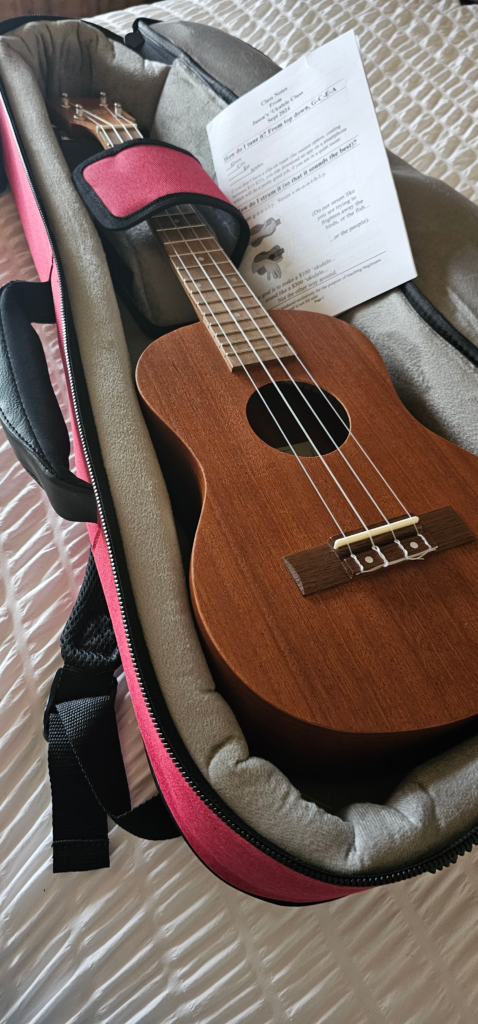
Then I came home, and vacation-me left the chat
Here’s the part the inspirational posts skip. Learning ukulele on a beach in Hawaii is one thing. Learning ukulele on a rainy Tuesday night in Washington, after a full day, when your fingertips are sore and the C chord you swore you knew yesterday has apparently moved — that’s a different sport.
The first few weeks were humbling in very specific ways. My fingers didn’t want to bend where fingers apparently need to bend. Chord changes that looked effortless in every video took me somewhere between four seconds and the heat death of the universe. And the information overload was real: every video, every forum, every well-meaning list of “10 things beginners must do” pointed in a slightly different direction. I’m an analytical person. I like systems. And I still felt like I was drinking from a firehose.
This is the point where, at 20, I probably would have quit — because at 20 I needed to be good at things quickly. It turns out that’s the first advantage of starting at 50: I’ve been bad at enough new things by now to know that “bad” is just the entrance fee.
What actually surprised me
A few honest discoveries from the first stretch, in no particular order.
Your hands adjust faster than your doubt does. The sore fingertips everyone warns you about? Real, but temporary. Within a few weeks I could press the strings without wincing. The voice saying “you’re too old for this” hung around considerably longer, and it turns out the only thing that quiets it is playing something — anything — that sounds like actual music. The first time a song was recognizable as the song, I played it about thirty more times in a row. My family was thrilled.
The hard part isn’t the chords. It’s the space between them. Learning a chord shape takes an evening. Getting from that chord to the next one without a long, contemplative pause — that’s the actual work, and nobody had told me that. Once I stopped judging myself for slow changes and started treating them as the whole point of practice, everything got less frustrating.
Being an adult is a genuine advantage. I don’t have a music teacher grading me. I don’t have anyone to impress. I know how I learn, I know how to be patient with a process, and I get to do this purely because I want to. Kids learn faster; adults learn on purpose. I’ll take my side of that trade.
One ukulele does not stay one ukulele. I should warn you about this now, because nobody warned me. There’s a condition in the ukulele world called UAS — Ukulele Acquisition Syndrome — and I would like to report that it is real, it is chronic, and I currently own five ukuleles. My wife has instituted policies. I am not currently in compliance with all of them.
Where I am now — honestly
Here’s the progress report, with no inflation: I’m a beginner. I can play songs — slowly, and with the occasional dramatic pause where a chord change should be. I work through structured courses, I keep a practice log because of course I do, and I’ve deliberately gone back to redo lessons instead of racing ahead, because I’d rather actually own a skill than have technically watched a video about it.
I’ve also fallen down a rabbit hole I didn’t expect: the baritone ukulele, which has become my main instrument. That’s a story for its own article. The short version is that starting late means you get to make choices based on what you love, not what you were handed.
I made a video about this whole journey — the trip, the doubt, the first months. If you’d rather hear it than read it, it’s right here:
So — are you too old to learn ukulele?
You already suspect the answer, or you wouldn’t have read this far. No. You’re not too old. But I’d go one step further: being older might actually be the best version of this. You’ll practice because you choose to. You’ll progress on your own terms. And you’ll get to feel the very specific, slightly ridiculous joy of being a genuine beginner at something again — which, at our age, is rarer and better than it sounds.
If you’re seriously thinking about starting, you’re probably already circling the same two questions I had that first week. I ended up writing about both, based on what I actually bought and what I’d do differently:
👉 How much should you spend on your first ukulele?
👉 How to choose your first ukulele
Start there. And if you end up walking out of a music store somewhere with a ukulele you didn’t plan to buy — welcome. You’re in good company.
Frequently asked questions
How long does it take to learn ukulele as a beginner?
Most beginners can play simple songs within a few weeks. Getting comfortable with chord changes and basic strumming patterns takes a few months of regular practice. “Learning ukulele” is an ongoing thing — but the point where it starts feeling like actual music rather than finger gymnastics comes sooner than you’d expect. For most adults I’ve heard from, a few months of consistent practice gets you there.
Is ukulele hard to learn for adults?
It’s one of the more accessible instruments for adult beginners. Four strings instead of six, lower string tension than guitar, and a compact size that’s easy to pick up and put down. The hard part isn’t the instrument — it’s the consistency. Adults tend to have less free time and higher self-expectations than kids. Once you make peace with being a beginner, the actual learning goes faster than you think.
What size ukulele should a beginner start with?
The standard advice is concert or tenor — they have more room between frets than soprano, which is easier on adult hands still finding their way around. Both are great starting points and I’d still recommend either of them.
But here’s the thing nobody told me: baritone is also worth serious consideration, especially if you have larger hands, a lower voice, or any background on guitar. It’s tuned differently (DGBE instead of GCEA) and has a deeper, warmer sound — less “tropical souvenir,” more actual instrument. It’s the one I ended up falling in love with, and it’s become my primary ukulele. I’ve got a whole article coming on why I chose baritone, but if you’re already curious, don’t let anyone talk you out of it just because it’s not the “standard” recommendation. For the full size breakdown, I wrote a complete guide to choosing your first ukulele.
How much should I spend on a first ukulele?
Enough to get a decent instrument, not so much that you’re stressed about it. The $50–$150 range covers a lot of solid beginner options. I’ve written about this in detail — including what I actually bought and what I’d do differently — in this guide to ukulele budgets for beginners.
Can you learn ukulele at 50, 60, or older?
Yes — and I’d argue the older you are, the more intentional you are about it, which actually helps. You’re not learning because someone made you. You’re learning because you want to. That motivation is worth more than younger fingers.