
Let me save you some time and some money: there is no single “best” first ukulele. I know that’s not what you came here to read. You wanted me to point at one and say “buy this one.” But figuring out how to choose your first ukulele is less about finding the perfect instrument and more about figuring out which one fits you — your hands, your ear, and the sound in your head you’re chasing.
When I bought my first ukulele in Hawaii, the guy at the shop walked me through the sizes before I touched a single one. He looked at my hands, asked what kind of sound I was after, and pointed me straight at the tenor. That five-minute conversation saved me from making the wrong call on day one. Consider this the version of that conversation you can have before you even walk into a store. Once you know which size you want, head over to my guide on how much to spend — the two go hand in hand.
First, the Sizes
This is the part nobody explains clearly to beginners, so they end up grabbing whatever’s on the shelf and hoping for the best. Ukuleles come in four main sizes, and the size changes everything — the sound, the feel, the spacing between the frets, even how the thing is tuned.
Here’s the key thing to understand: a bigger ukulele isn’t “better” than a smaller one. They’re different instruments for different players and different sounds. The goal isn’t to buy the biggest or the most expensive one — it’s to match the size to your hands and the sound you want. Let’s go through them from smallest to largest.
Soprano — The Classic
This is the little one. The sound everyone pictures when they hear the word “ukulele” — bright, plinky, cheerful, unmistakably tropical. It’s the smallest of the four, the most affordable as a rule, and the most portable. If you want the instrument that sounds the way ukuleles sound in your head, this is it.
The catch is the size. The frets are tiny and packed close together, which can be genuinely frustrating if you have larger hands. Fingers that land cleanly on a tenor will feel like they’re tripping over each other on a soprano. I have larger hands, and the soprano was never going to be my instrument — but we’ll come back to that. If you have smaller hands or you’re buying for a kid, the soprano is a fantastic starting point.
Concert — The Middle Ground
A step up in size from the soprano. You get a little more room between the frets, a slightly fuller and warmer sound, and you keep most of that classic ukulele brightness. It’s still very portable — easy to toss in a bag and take anywhere — which is exactly why it’s so popular.
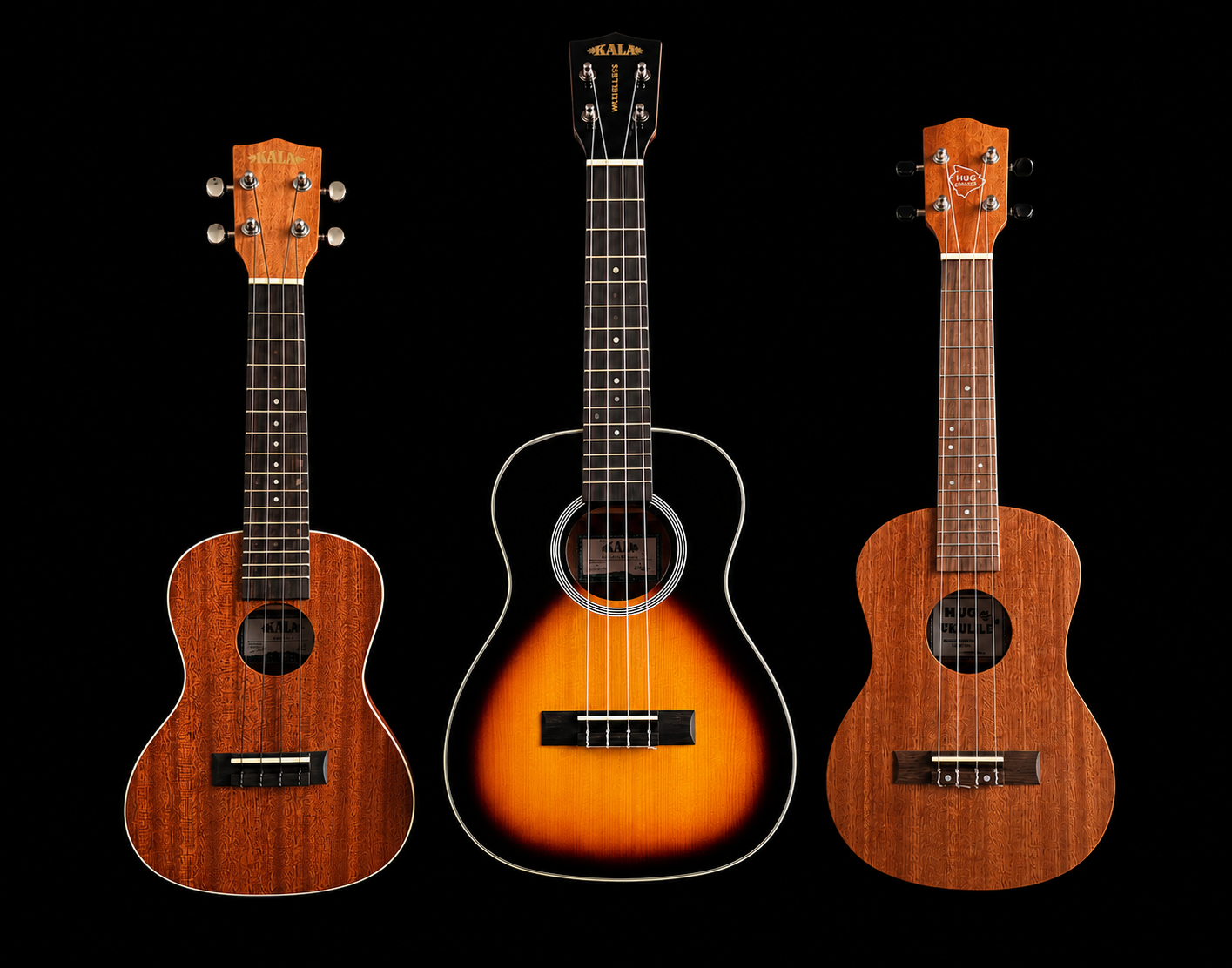
My Kala KA-C concert is the one I grab when I’m traveling. It’s compact, sounds great for its size, and doesn’t take up much space, but the extra room over a soprano makes it noticeably more comfortable to actually play. A lot of beginners land on a concert and never feel the need to go any bigger. If you want one ukulele that does a little of everything without committing to a large body, this is a safe, smart choice.
Tenor — The Popular Choice
Bigger again, and for many adult beginners, this is the sweet spot. You get real space to fit your fingers between the frets, a richer and louder sound, and more sustain — notes ring out longer and fuller. It still tunes the same as a soprano and concert, so everything you learn transfers directly between them.
My very first ukulele was a HUG tenor I bought in Hawaii, and the extra room made learning chords noticeably less awkward right from the start. When the shop owner looked at my hands and steered me toward the tenor, he was right — I’d have spent my first month fighting a smaller neck instead of learning. If you’re an adult, especially one with average-to-large hands, and you want one ukulele that’s comfortable to learn on and sounds full, the tenor is hard to beat.
Baritone — The Outlier
The biggest of the bunch, and the odd one out. A baritone is tuned differently from the other three — D-G-B-E instead of the standard G-C-E-A — which means it sounds deeper and warmer, closer to the top four strings of a guitar. That different tuning is the thing to understand before you buy one: chord shapes you learn on a baritone won’t directly match what you’d play on the smaller sizes.
Here’s the part I have to be honest about: when figuring out how to choose your first ukulele, most people don’t even consider the baritone — but it’s my favorite. My Kala baritone is the one I play most, the one that just sat right in my hands the first time I picked it up — that warm, deep sound and the way it settled in felt like coming home. If you’ve played guitar before, the baritone tuning will feel weirdly familiar, and you’ll likely be playing recognizable chords within minutes. The trade-off is that it’s the least “ukulele-sounding” of the four and the least portable. For the right person, though, it’s perfect.
So Which Size Is Right for You?
By now you might already feel pulled toward one. But if you’re still on the fence, here’s the honest framework I’d give a friend who asked me over coffee:
If you have bigger hands — go tenor or baritone. The cramped frets on a soprano are a real source of beginner frustration, and there’s no reason to fight your own fingers while you’re also trying to learn chords for the first time. I struggled on smaller necks until I gave myself permission to size up, and everything got easier the moment I did.
If you want the “classic” ukulele sound — soprano or concert. That bright, sunny, unmistakable tone is the reason a lot of people fall in love with the instrument in the first place. If that sound is what’s pulling you in, don’t let anyone talk you out of it.
If you’ve played guitar before — seriously consider a baritone. The tuning overlap means you’ll be playing chords you already half-recognize almost immediately, which is a huge confidence boost in those first shaky weeks when most people are tempted to quit.
If you genuinely have no idea — get a concert or tenor. They’re the most forgiving middle ground, comfortable for the widest range of hand sizes, and they sound great without being either too tiny or too unusual. You really can’t go wrong, and you’ll have plenty of time to develop preferences later.
Beyond Size — What Actually Matters
Once you’ve narrowed down the size, the rest comes down to a few things that are surprisingly easy to overlook in a store when you’re excited and a shiny new instrument is calling your name. These are the things that separate an instrument you’ll love from one that quietly ends up in a closet.
Playability over looks. This is the big one. A gorgeous ukulele that’s set up badly will fight you on every single chord. The thing to pay attention to is the action — the height of the strings above the fretboard. If the strings sit too high, pressing down a chord feels like a finger workout, every note takes effort, and you’ll blame yourself when the instrument is actually the problem. A plain-looking ukulele that plays beautifully beats a stunning one that’s a struggle, every time.
Does it stay in tune? Cheaper ukuleles often come with bad tuners that drift constantly, and nothing kills practice momentum faster than having to retune every three minutes. Look for geared tuners (the kind that stick out the back at an angle) rather than friction pegs — they hold tune far better and they’re worth seeking out even on a budget instrument.
Does it feel right in your hands? This sounds vague, but it might be the most important factor of all. When I tried a handful of ukuleles in Hawaii, one of them just settled into my hands in a way I genuinely couldn’t put into words. It wasn’t the prettiest or the most expensive — it just felt right. If you can get to a shop and hold a few, do it. Strum them, hold them against your body, see which one disappears into your hands. That feeling is real, and it’s worth trusting.
Solid top or laminate? You’ll see this debate everywhere, and beginners often worry about it more than they need to. A solid-top ukulele generally sounds richer and opens up over time, while a laminate is more affordable and more durable. The honest truth: a good laminate is completely fine to learn on, and plenty of players never feel the need to upgrade. Don’t let this question stall your decision.
How to Choose Your First Ukulele Without Overthinking It
If I had to boil down how to choose your first ukulele to one sentence: pick a concert or tenor in the $100–$200 range from a brand you can trust, make sure it’s set up well, and don’t agonize over getting it perfect. That combination gives the vast majority of beginners an instrument that’s comfortable, sounds good, stays in tune, and won’t hold them back as they improve.
And here’s the thing nobody warns you about — your first ukulele is rarely your last one. Not because you chose wrong, but because once you start, you start wanting to try the others. The bright soprano. The deep baritone. The one in the pretty wood you saw online at 1 a.m. There’s no cure for UAS — Ukulele Acquisition Syndrome — there’s only management. My wife would like it on the record that I am not managing it well.
If you want to see exactly which three I ended up with — and which one is still my favorite — they’re all on my Gear page. And if you haven’t worked out your budget yet, start with my honest breakdown of how much to spend on a ukulele first — size and budget go hand in hand. When you’re ready to actually learn the thing, Uke Like the Pros is where I’d point any beginner.
Until next time — keep forging.