
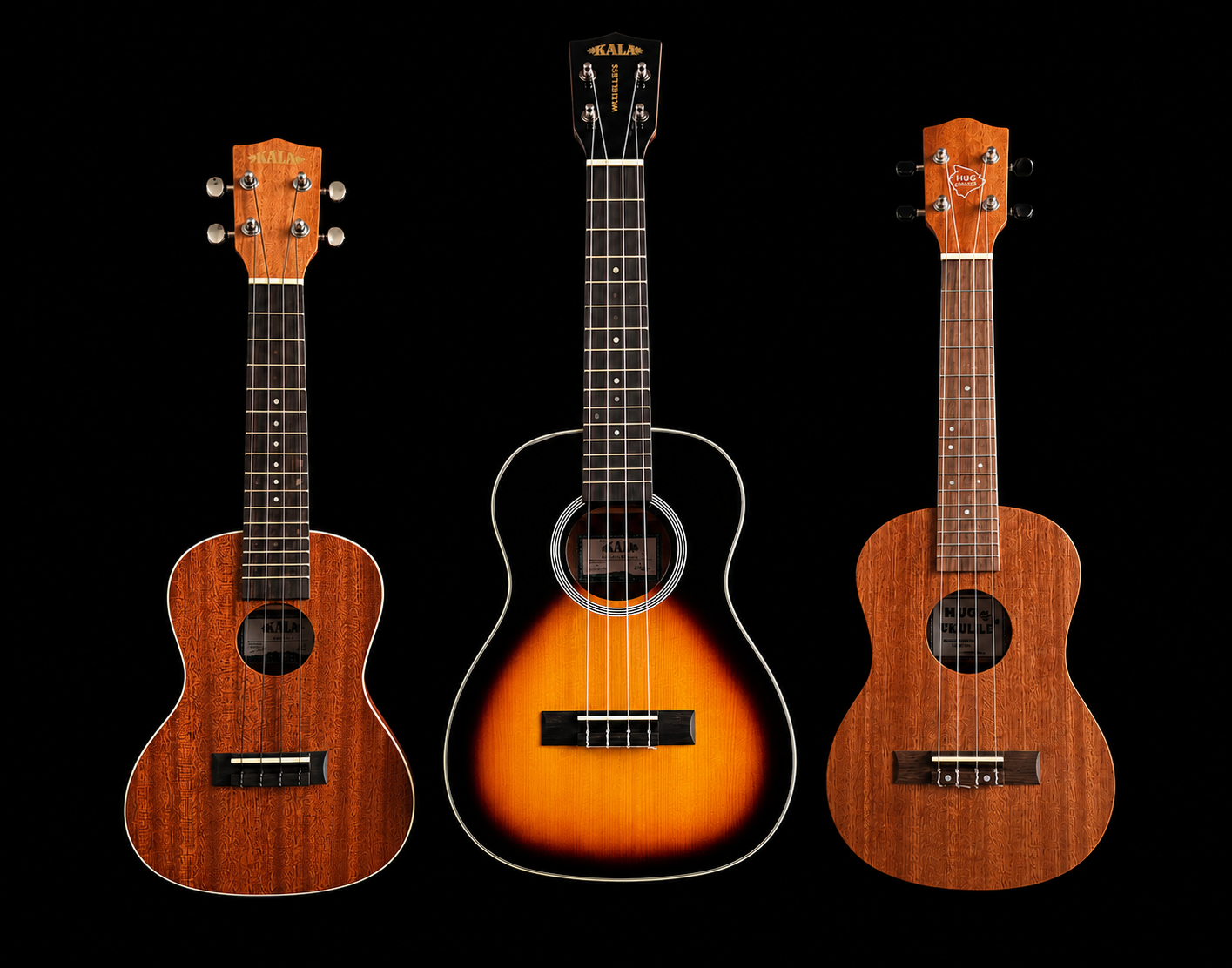
Let me start with a confession: I am not the person who should be giving anyone financial advice. I currently own three ukuleles. My wife has the receipts. So take everything here with that in mind.
But here’s the thing — I started this whole journey at 50, knowing nothing, and figuring out how much to spend on ukulele as a beginner was the single most useful question I never got a straight answer to. Everyone either says “you can get one for $30!” or tries to sell you something that costs more than my first car. Neither one helped me.
So here’s the honest answer on how much to spend on ukulele, from someone who’s now bought more ukuleles than any reasonable beginner should.
The Real Mistake Most Beginners Make
It’s not buying the wrong size. It’s not picking the wrong brand. It’s buying something so cheap that it actively fights you while you’re trying to learn.
A $25 ukulele off the shelf at a big box store sounds bad, won’t stay in tune, and often has action so high (that’s the distance between the strings and the fretboard) that pressing down a chord feels like a finger workout. You’ll think you’re failing. You’re not — your instrument is just sabotaging you.
I know because I’ve played them. They’re the reason a lot of people quit in the first month and decide they’re “not musical.” You’re musical. The $25 uke is the problem.
What You Should Actually Spend
Here’s how I break down how much to spend on ukulele, based on what I’ve bought and what I’d tell a friend. (Not sure which size or type to get yet? Start with my guide on how to choose your first ukulele first — size affects budget.)
Under $50 — Just Don’t
I know it’s tempting. It’s a ukulele-shaped object that produces sound. But this is the price range where you find the instruments that make learning harder. Skip it. The money you “save” here you’ll spend again in three months buying the ukulele you should have started with.
$50 to $100 — The Danger Zone
This range is tricky. There are some genuinely good beginner ukuleles here, and there’s also a lot of junk dressed up to look nice. My Kala KA-C Concert lives in this range — I caught it on sale and it’s a legitimately good instrument. But buying blind in this bracket is a gamble. Stick to known brands and you’ll be fine. Wander off into the unknown and you’re rolling the dice.
$100 to $200 — The Sweet Spot
This is where I’d point almost any beginner. For this money you get a ukulele that stays in tune, sounds good, plays comfortably, and won’t need replacing the moment you get decent. My baritone sits right at the top of this range and it’s the one I play most. You are not overpaying here — you’re buying something that won’t hold you back.
$200 and Up — Probably Not Yet
There are beautiful ukuleles north of $200, and someday maybe one of them ends up in my collection (don’t tell my wife). But as a beginner? You don’t need it. You won’t hear the difference yet, and you’ll likely want a different size or sound once you actually know what you like. Save the upgrade for when you’ve earned it.
Laminate vs. Solid Top — Does It Matter?
You’ll see this debate everywhere, and people get weirdly intense about it. Here’s the short version.
A solid top ukulele has a top made from a single piece of wood, and it generally sounds richer and opens up more over time. A laminate ukulele uses layered wood — it’s cheaper, more durable, and handles humidity changes better (which, living near Seattle, I do not take lightly).
The honest truth for a beginner: a good laminate ukulele is completely fine. You will learn every bit as well on one. Don’t let anyone make you feel like you need a solid top to start. You don’t. When your ear gets good enough to care, you’ll know — and that’s a great excuse for ukulele number two anyway.
Brands Worth Trusting
I’ll start with Kala because I own two of them and they’ve both treated me well. Beyond that, here are the names I’d actually recommend to a beginner:
- Kala — The reliable default. Wide range, consistent quality, easy to find. Two of my three are Kalas.
- Ohana — Excellent value. Punches above its price.
- Islander — Known for a slightly wider nut, which some players (especially us with bigger hands) really appreciate.
- Flight — More modern looks, solid playability.
- Snail — Warm tone, underrated.
- Enya — Often offers solid-top models at surprisingly reasonable prices.
Any of these will give you a real instrument rather than a toy.
Where to Buy
If you can, go to a local music shop first. Hold a few. Hear them. Ask an employee to play each one for you — the right one tends to call to you (this is also how the trouble starts, but that’s a different article).
If a local shop isn’t an option, there are excellent ukulele-specific online stores like Mim’s Ukes, Uke Republic, The Ukulele Site, and Aloha City Ukuleles — many of which do a proper setup before shipping, which matters more than you’d think. And if you’re buying on Amazon, stick to the named brands above rather than whatever no-name model is on sale that week. If you want structured lessons alongside your new instrument, Uke Like the Pros is where I’d point any beginner. And if you want to see the exact ukuleles I ended up with, check out my Gear page.
The Starter Package Math
One last thing nobody tells you. A ukulele isn’t the only cost. To actually get going you’ll want a few extras: a case or gig bag, a clip-on tuner, maybe a spare set of strings. Bundle that with a sweet-spot ukulele and you’re realistically looking at somewhere around $150 to $250 all in.
And if you want to spend $40 to $60 more, getting your ukulele professionally set up — where someone adjusts the action and dials it in — is one of the best small investments you can make. It’s the difference between an instrument that fights you and one that wants to be played.
How Much to Spend on Ukulele: Our Recommendation
If you want the one-sentence version: aim for $100 to $200, buy from a name you can trust, and get it set up if you can. That’s the range where a ukulele stops being an obstacle and starts being an instrument.
And then, if you’re anything like me, you’ll buy a second one a few months later. And a third. There’s no cure for UAS — Ukulele Acquisition Syndrome — but at least now you’ll start in the right place.
Until next time — keep forging.